Friday, February 21, 2014

Bank stocks lead the market higher

Dow 10

Click for more market data.

NEW YORK (CNNMoney) Stocks had a rough start this week, but the market seems to be finding its footing thanks to strong bank earnings.

The Dow Jones industrial average, the S&P 500 and the Nasdaq were all higher Wednesday, extending Tuesday's gains. The S&P 500 is within a few points of erasing its losses for the year.

CNNMoney's Tech 30 index was also higher, with Twitter (TWTR) and Apple (AAPL, Fortune 500) both up in early trading.

Bank of America (BAC, Fortune 500) boosted investor confidence by reporting better-than-expected earnings and revenue for the fourth quarter. The report follow solid earnings figures Tuesday from JPMorgan (JPM, Fortune 500) and Wells Fargo (WFC, Fortune 500). Shares of Bank of America rose on the news, as did major banks that have yet to report such as Goldman Sachs (GS, Fortune 500) and Citigroup (C, Fortune 500).

The financial sector is expected to have the best profit growth in the fourth quarter, according to FactSet Research. Overall, earnings for the companies in the S&P 500 are expected to be up 6.1% versus the fourth quarter of last year.

In economic news, producer prices increased 0.4% in December, the government said. Manufacturing activity in the New York area expanded at a rapid pace in January, according to the Federal Reserve Bank of New York. At 2:00 p.m., the Federal Reserve will release the latest edition of its Beige Book report, a compilation of data on regional economies.

Wednesday's reports "added to renewed market optimism," following solid December retail sales and business inventories data on Tuesday, said Michael Englund, an economist at Action Economics. Despite an unexpected slowdown in hiring last month, "the bulk of U.S. economic surprises remain upward," he added.

General Motors (GM, Fortune 500) shares fell even though the automaker announced on Tuesday that it will pay its first dividend since 2008. The stock was down because the company said Wednesday morning that it expects 2014 profit margins to be similar to last year and that restructuring costs for fixing problems in Europe are expected to be about $1.1 billion. The automaker also predicted most growth globally for the industry this year.

But shares of electric automaker Tesla Motors (TSLA) surged again after CEO Elon ! Musk told CNN late Tuesday that the company is on track to produce a cheaper, mass-market car in three years and still plans to offer a full-size pickup similar to the Ford (F, Fortune 500) F-150 in four to five years.

Shares of 3D printer maker ExOne (XONE) fell sharply after it warned late Tuesday that revenue would be far below its earlier forecasts. The warning follows disappointing guidance from 3D printer maker Stratasys (SSYS) earlier in the day. Fellow 3D printer companies 3D Systems (DDD) and Voxeljet (VJET) were down in early trading as well.

The main European stock market indexes were all up Wednesday afternoon. Burberry (BBRYF) shares surged in London after the luxury retailer reported a 14% jump in retail revenue in the third quarter, which includes the holiday season. Asian markets mostly closed the day with gains. To top of page

Wednesday, February 19, 2014

George Soros Identifies the Main Challenges Investors Face in the Coming Years

Hot Value Companies To Buy For 2015

NEW YORK – As 2013 comes to a close, efforts to revive growth in the world's most influential economies – with the exception of the eurozone – are having a beneficial effect worldwide. All of the looming problems for the global economy are political in character.

After 25 years of stagnation, Japan is attempting to reinvigorate its economy by engaging in quantitative easing on an unprecedented scale. It is a risky experiment: faster growth could drive up interest rates, making debt-servicing costs unsustainable. But Prime Minister Shinzo Abe would rather take that risk than condemn Japan to a slow death. And, judging from the public's enthusiastic support, so would ordinary Japanese.

By contrast, the European Union is heading toward the type of long-lasting stagnation from which Japan is desperate to escape. The stakes are high: Nation-states can survive a lost decade or more; but the EU, an incomplete association of nation-states, could easily be destroyed by it.

The euro's design – which was modeled on the Deutsche Mark – has a fatal flaw. Creating a common central bank without a common treasury means that government debts are denominated in a currency that no single member country controls, making them subject to the risk of default. As a consequence of the crash of 2008, several member countries became over indebted, and risk premia made the eurozone's division into creditor and debtor countries permanent.

This defect could have been corrected by replacing individual countries' bonds with Eurobonds. Unfortunately, German Chancellor Angela Merkel, reflecting the radical change that Germans' attitudes toward European integration have undergone, ruled that out. Prior to reunification, Germany was the main motor of integration; now, weighed down by reunification's costs, German taxpayers are determined to avoid becoming European debtors' deep pocket.

After the crash of 2008, Merkel insisted that each country should look after its own financial institutions and government debts should be paid in full. Without realizing it, Germany is repeating the tragic error of the French after World War I. Prime Minister Aristide Briand's insistence on reparations led to the rise of Hitler; Angela Merkel's policies are giving rise to extremist movements in the rest of Europe.

The current arrangements governing the euro are here to stay, because Germany will always do the bare minimum to preserve the common currency – and because the markets and the European authorities would punish any other country that challenged these arrangements. Nonetheless, the acute phase of the financial crisis is now over. The European financial authorities have tacitly recognized that austerity is counterproductive and have stopped imposing additional fiscal constraints. This has given the debtor countries some breathing room, and, even in the absence of any growth prospects, financial markets have stabilized.

Future crises will be political in origin. Indeed, this is already apparent, because the EU has become so inward-looking that it cannot adequately respond to external threats, be they in Syria or Ukraine. But the outlook is far from hopeless; the revival of a threat from Russia may reverse the prevailing trend toward European disintegration.

As a result, the crisis has transformed the EU from the "fantastic object" that inspired enthusiasm into something radically different. What was meant to be a voluntary association of equal states that sacrificed part of their sovereignty for the common good – the embodiment of the principles of an open society – has now been transformed by the euro crisis into a relationship between creditor and debtor countries that is neither voluntary nor equal. Indeed, the euro could destroy the EU altogether.

In contrast to Europe, the United States is emerging as the developed world's strongest economy. Shale energy has given the US an important competitive advantage in manufacturing in general and in petrochemicals in particular. The banking and household sectors have made some progress in deleveraging. Quantitative easing has boosted asset values. And the housing market has improved, with construction lowering unemployment. The fiscal drag exerted by sequestration is also about to expire.

More surprising, the polarization of American politics shows signs of reversing. The two-party system worked reasonably well for two centuries, because both parties had to compete for the middle ground in general elections. Then the Republican Party was captured by a coalition of religious and market fundamentalists, later reinforced by neo-conservatives, that moved it to a far-right extreme. The Democrats tried to catch up in order to capture the middle ground, and both parties colluded in gerrymandering Congressional districts. As a consequence, activist-dominated party primaries took precedence over general elections.

That completed the polarization of American politics. Eventually, the Republican Party's Tea Party wing overplayed its hand. After the recent debacle of the government shutdown, what remains of the Republican establishment has begun fighting back, and this should lead to a revival of the two-party system.

Continue reading here. 


Also check out: George Soros Undervalued Stocks George Soros Top Growth Companies George Soros High Yield stocks, and Stocks that George Soros keeps buying
About the author:Canadian Valuehttp://valueinvestorcanada.blogspot.com/
Currently 0.00/512345

Rating: 0.0/5 (0 votes)

Email FeedsSubscribe via Email RSS FeedsSubscribe RSS Comments Please leave your comment:
More GuruFocus Links
Latest Guru Picks Value Strategies
Warren Buffett Portfolio Ben Graham Net-Net
Real Time Picks Buffett-Munger Screener
Aggregated Portfolio Undervalued Predictable
ETFs, Options Low P/S Companies
Insider Trends 10-Year Financials
52-Week Lows Interactive Charts
Model Portfolios DCF Calculator
RSS Feed Monthly Newsletters
The All-In-One Screener Portfolio Tracking Tool
MORE GURUFOCUS LINKS
Latest Guru Picks Value Strategies
Warren Buffett Portfolio Ben Graham Net-Net
Real Time Picks Buffett-Munger Screener
Aggregated Portfolio Undervalued Predictable
ETFs, Options Low P/S Companies
Insider Trends 10-Year Financials
52-Week Lows Interactive Charts
Model Portfolios DCF Calculator
RSS Feed Monthly Newsletters
The All-In-One Screener Portfolio Tracking Tool
SPY STOCK PRICE CHART 184.14 (1y: +25%) $(function() { var seriesOptions = [], yAxisOptions = [], name = 'SPY', display = ''; Highcharts.setOptions({ global: { useUTC: true } }); var d = new Date(); $current_day = d.getDay(); if ($current_day == 5 || $current_day == 0 || $current_day == 6){ day = 4; } else{ day = 7; } seriesOptions[0] = { id : name, animation:false, color: '#4572A7', lineWidth: 1, name : name.toUpperCase() + ' stock price', threshold : null, data : [[1358143200000,146.97],[1358229600000,147.07],[1358316000000,147.05],[1358402400000,148],[1358488800000,148.33],[1358834400000,149.13],[1358920800000,149.37],[1359007200000,149.41],[1359093600000,150.25],[1359352800000,150.07],[1359439200000,150.66],[1359525600000,150.07],[1359612000000,149.7],[1359698400000,151.24],[1359957600000,149.53],[1360044000000,151.05],[1360130400000,151.16],[1360216800000,150.96],[1360303200000,151.8],[1360562400000,151.77],[1360648800000,152.02],[1360735200000,152.15],[1360821600000,152.29],[1360908000000,152.11],[1361253600000,153.25],[1361340000000,151.34],[1361426400000,150.42],[1361512800000,151.89],[1361772000000,149],[1361858400000,150.02],[1361944800000,151.91],[1362031200000,151.61],[1362117600000,152.11],[1362376800000,152.92],[1362463200000,154.29],[1362549600000,154.5],[1362636000000,154.78],[1362722400000,155.44],[1362978000000,156.03],[1363064400000,155.68],[1363150800000,155.91],[1363237200000,156.73],[1363323600000,155.83],[1363582800000,154.97],[1363669200000,154.61],[1363755600000,155.69],[1363842000000,154.36],[1363928400000,155.6],[1364187600000,154.95],[1364274000000,156.19],[1364360400000,156.19],[1364446800000,156.67],[1364533200000,156.67],[1364792400000,156.05],[1364878800000,156.82],[1364965200000,155.23],[1365051600000,155.86],[1365138000000,155.16],[1365397200000,156.21],[1365483600000,156.75],[1365570000000,158.67],[1365742800000,158.8],[1366002000000,155.12],[1366088400000,157.41],[1366174800000,155.11],[1366261200000,154.14],[1366347600000,155.48],[1366606800000,156.17],[1366693200000,157.78],[1366779600000,157.88],[1366866000000,158.52],[1366952400000,158.24],[1367211600000,159.3],[1367298000000,159.68],[1367384400000,158.28],[1367470800000,159.75],[1367557200000,161.37],[1367816400000,161.78],[1367902800000,162.6],[1367989200000,163.34],[1368075600000,162.88],[1368162000000,163.41],[1368421200000,163.54],[1368507600000,165.23],[1368594000000,166.12],[1368680400000,165.34],[1368766800000,166.94],[1369026000000,166.93],[1369112400000,167.17],! [1369198800000,165.93],[1369285200000,165.45],[1369371600000,165.31],[1369630800000,165.31],[1369717200000,166.3],[1369803600000,165.22],[1369890000000,165.83],[1369976400000,163.45],[1370235600000,164.35],[1370322000000,163.56],[1370408400000,161.27],[1370494800000,162.73],[1370581200000,164.8],[1370840400000,164.8],[1370926800000,163.1],[1371013200000,161.75],[1371099600000,164.21],[1371186000000,163.18],[1371358800000,163.18],[1371445200000,164.44],[1371531600000,165.74],[1371618000000,163.45],[1371704400000,159.4],[1371790800000,159.07],[1372050000000,157.06],[1372136400000,158.58],[1372222800000,160.14],[1372309200000,161.08],[1372395600000,160.42],[1372654800000,161.36],[1372741200000,161.21],[1372827600000,161.28],[1372914000000,161.28],[1373000400000,163.02],[1373259600000,163.95],[1373346000000,165.13],[1373432400000,165.19],[1373518800000,167.44],[1373605200000,167.51],[1373864400000,168.16],[1373950800000,167.53],[1374037200000,167.95],[1374123600000,168.87],[1374210000000,169.17],[1374469200000,169.5],[1374555600000,169.14],[1374642000000,168.52],[1374728400000,168.93],[1374814800000,169.11],[1375074000000,168.59],[1375160400000,168.59],[1375246800000,168.71],[1375333200000,170.66],[1375419600000,170.95],[1375678800000,170.7],[1375765200000,169.73],[1375851600000,169.18],[1375938000000,169.8],[1376024400000,169.31],[1376283600000,169.11],[1376370000000,169.61],[1376456400000,168.74],[1376542800000,166.38],[1376629200000,165.83],[1376888400000,164.77],[

Monday, February 17, 2014

The ticking time bomb of forced drawdowns on variable annuities

Advisers' elderly clients who hold older variable annuities have a ticking time bomb on their hands: potential forced annuitization that will deactivate their accrued death benefits.

Buried within the fine print of variable annuity prospectuses, insurers detail the conditions under which they will distribute a client's annuity in the form of a stream of payments. When signing up for a contract, clients can choose an annuity commencement date — the date on which they will begin receiving income payouts — but insurers usually set an upper limit on the age by which clients must start receiving payouts. Typically, this ranges anywhere between the mid-80s to as late as 95 or 100, depending on the carrier and the terms of the contract.

Advisers are finding, however, that though some insurers used to be willing to extend the annuitization date on a case-by-case basis, they are now pushing to begin disbursement of the account as soon as possible. This has been particularly debilitating for clients who have death benefits that are significantly larger than their account values. What's worse, is that there's no way out of the contractual agreement.

Those most affected by it are clients with dollar-for-dollar death benefits, where the value of the death benefit is reduced by the exact dollar value of any withdrawals made from the account value. These features were customary with older annuity contracts. In the past, advisers would recommend that clients “strip” the account value by making a withdrawal, investing the money elsewhere and allowing the contract to continue with a small account value and a large death benefit.

Such was the case for Thomas B. Hamlin, founder of Somerset Wealth Strategies LLC. He has a 92-year-old client with an $81,000 death benefit and an account value of about $10,000. “For the last couple of years, he's been allowed to extend the annuity commencement date, and now the company wants to force him to annuitize, liquidate or exchange the contract,” Mr. Hamlin said. “He would lose the death benefit, which is a massive loss for his estate.”

In other scenarios, required minimum distributions from a variable annuity could also lead to the loss of the death benefit.

Scott Stolz, president of Raymond James Insurance Group, offered an example: A client has $70,000 in the account value and a dollar-for-dollar death benefit worth $130,000. The client pulls $65,000 from the account. His death benefit is reduced by the same amount, falling to a death benefit of $65,000 on an account value of $5,000. However, required minimum distributions from the account value will lead to a zero balance in a short period of time.

RMD calculations on variable annuities with dollar-for-dollar death benefits become problematic because they are based on the sum of the account value and the actuarial present value of the death benefit that's over the account value, according to Mr. Stolz. The problem here is that the RMDs calculated this way will quickly deplete the account value.

“The rate at which they liquidate the account, the client will have all of the money out of the policy in about s! ix or seven years, and at this point, the death benefit will go away: The account value hits zero and the death benefit hits zero,” Mr. Stolz said. The alternatives are limited in this case, but there's the possibility of taking an RMD from another source.

Top 5 Canadian Stocks To Invest In 2015

Generally, there are few ways out of a forced annuitization. Clients and advisers haven't been fully aware of its perils, and wholesalers historically haven't discussed the issue much.

“The information is in the fine print, and wholesalers will say that their companies don't do that, but they can,” said Carrie Turcotte, president of Crest Financial Strategies “So you have to ask, 'At what age can the company force it?'”

Nevertheless, the forced annuitization age is a detail that's buried within the prospectus, so there's a cautionary tale for advisers.

“It's never as easy as the product reps or wholesalers make it sound, and it's our job to dig as deep as we can in the comprehension of these contracts,” said Ms. Turcotte.

Sunday, February 16, 2014

Best Internet Stocks For 2015

Continuing its efforts to transform itself from a pure Internet service provider into an information technology company, EarthLink (NASDAQ: ELNK  ) announced Monday it is buying�cloud computing and hosted IT services provider CenterBeam for $22 million.�

California-based CenterBeam�provides remote managed IT services primarily to mid-sized businesses, and operates a 140-person IT support center that offers help desk assistance, desktop technical support, and application support services. �

Believing the acquisition will allow the ISP to "fast track" the implementation of its IT services product development while also providing "expertise, scale, and redundancy," EarthLink Chairman and CEO�Rolla P. Huff said: "CenterBeam's advanced set of products, tools, and processes will enable us to quickly bring a robust set of remote managed IT Services and collaboration services to market."

EarthLink intends to offer CenterBeam's cloud computing portfolio, which� provides a full suite of collaboration services, along with its nationwide hosted voice platform, through its existing distribution channels.

Best Internet Stocks For 2015: Symantec Corporation(SYMC)

Symantec Corporation provides security, storage, and systems management solutions internationally. The company?s Consumer segment delivers Internet security, PC tune-up, and online backup solutions and services to individual users and home offices. Its Security and Compliance segment provides solutions for endpoint security and management, compliance, messaging management, data loss prevention, encryption, and authentication services to large, medium, and small-sized businesses, as well as offers solutions through its software-as-a-service (SaaS) security offerings. This segment?s products enable customers to secure, provision, and remotely manage their laptops, PCs, mobile devices, and servers. The company?s Storage and Server Management segment provides storage and server management, backup, archiving, and data protection solutions across heterogeneous storage and server platforms, as well as solutions delivered through its SaaS offerings to large, medium, and small-s ized businesses. Symantec?s Services segment offers implementation services and solutions, including consulting, business critical services, education, and managed security services. The company also provides various enterprise support offerings, such as annual maintenance support contracts, including content, upgrades, and technical support. It sells its products through its eCommerce platform, as well as through distributors, direct marketers, Internet-based resellers, system builders, ISPs, and retail locations worldwide. Symantec markets and sells its products through distributors, retailers, direct marketers, Internet-based resellers, original equipment manufacturers, system builders, and Internet service providers; and its e-commerce channels, as well as direct sales force, value-added and large account resellers, and system integrators. The company was founded in 1982 and is headquartered in Mountain View, California.

Advisors' Opinion:
  • [By Shauna O'Brien]

    On Thursday, Morgan Stanley reported that it has downgraded security and storage management company Symantec Corporation (SYMC).

    Morgan Stanley has cut its rating on SYMC to an “Equal Weight.” Analysts believe that the company lacks near term catalysts.

    Symantec shares were down 55 cents, or 2.18%, during pre-market trading Thursday. The stock is up 34% YTD.

  • [By Reuters]

    Peter Parks, AFP/Getty ImagesThe 12-story building in Shanghai's northern suburb of Gaoqiao where a Chinese military-led hacking group allegedly conducted a series of attacks on U.S. companies networks. BOSTON -- Cybersecurity company FireEye has acquired Mandiant, the computer forensics specialist best known for unveiling a secretive Chinese military unit believed to be behind a series of hacking attacks on U.S. companies. FirEye (FEYE) shares jumped more than 20 percent after Thursday's announcement of the $1.05 billion cash-and-stock deal, which FireEye said closed Monday. It unites two companies with relatively new technologies for thwarting cyber attacks, and brings together two of the most-respected executives in the security industry: FireEye CEO Dave DeWalt and Mandiant founder Kevin Mandia. While sales of older anti-virus products have been on the decline, security experts expect strong growth in both FireEye's cloud-based systems for detecting malicious software and Mandiant's software that analyzes cyber attacks. About a year ago the two companies entered into a technology development agreement that made it easier to deploy their products together. With the merger, FireEye will gain Mandiant's team of forensics investigators. "They have these very strong Navy 'cyber' Seals who respond to breaches and are very good at what they do," DeWalt said about Mandiant. He had previously served as chairman of Mandiant's board. "My aim is to create the strongest security company in the world," DeWalt said in an interview. FireEye, which has yet to post a profit, said the acquisition will be immediately accretive to earnings and expects the combined company's revenue to grow about 50 percent this year. In comparison, Symantec (SYMC), the biggest maker of anti-virus software, has said it expects fiscal 2014 revenue to drop 3 percent to 4 percent. Mandiant is best known for its forensics services. The company rose to prominence in February 2013 when it pu

Best Internet Stocks For 2015: Yahoo! Inc.(YHOO)

Yahoo! Inc., together with its subsidiaries, operates as a digital media company that delivers personalized digital content and experiences through various devices worldwide. It offers online properties and services to users; and a range of marketing services to businesses. The company?s communications and communities offerings include Yahoo! Mail, Yahoo! Messenger, Yahoo! Groups, Yahoo! Answers, Flickr, and Connected TV, which provide a range of communication and social services to users and small businesses enabling users to organize into groups and share knowledge, common interests, and photos. Its search products comprise Yahoo! Search and Yahoo! Local, available free to users to navigate the Internet and discover content. The company?s marketplaces offerings and services include Yahoo! Shopping, Yahoo! Travel, Yahoo! Real Estate, Yahoo! Autos, and Yahoo! Small Business, which allow users to research specific topics, products, services, or areas of interest by review ing and exchanging information, obtaining contact details, or considering offers from providers of goods, services, or parties with similar interests. Its media offerings comprise Yahoo! Homepage, Yahoo! News, Yahoo! Sports, Yahoo! Finance, My Yahoo!, Yahoo! Toolbar, Yahoo! Entertainment & Lifestyles, Yahoo! Contributor Network, and Yahoo! Pulse, which are designed to engage users with online content and services on the Web. The company also offers marketing services, such as display and search advertising, listing-based services, and commerce-based transactions to advertisers. In addition, it provides software and platform offerings for third-party developers, advertisers, and publishers, such as Yahoo! Developer Network, Yahoo! Open Strategy, Yahoo! Application Platform, Yahoo! Updates, Yahoo! Query Language, and Yahoo! Search BOSS. The company has strategic alliances with Nokia and ABC News, Inc. Yahoo! Inc. was founded in 1994 and is headquartered in Sunnyvale, Californi a.

Advisors' Opinion:
  • [By WWW.MARKETWATCH.COM]

    SAN FRANCISCO (MarketWatch) -- Shares of Facebook (FB) , Yahoo (YHOO) and Netflix (NFLX) were among the hardest hit in the tech sector on Tuesday afternoon, as the government shutdown dragged into its second week with no end in site -- feeding a growing selloff across the market. By early afternoon, Facebook shares were off 6.3% to $47.33 while Netflix was off by 5.5% and Yahoo was down 5.5%. Those three have been among the strongest performers in the tech sector this year; Netflix shares were up nearly 225% from the first of the year, while Facebook is up more than 77% and Yahoo has surged by 62%. The tech-heavy Nasdaq Composite, by comparison, is up about 22% for the year to date. The Nasdaq was off about 1.8% to 3,702 by early afternoon on Tuesday, with the Dow shedding more than 100 points.

  • [By Ishfaque Faruk]

    Yahoo!� (NASDAQ: YHOO  ) �has done very well in 2013, with shares at 52-week highs. The company has made stellar progress in acquiring valuable technological assets, and has seen an increase in user traffic to its various online portals. The company's decision to hold onto a larger part of Alibaba will increase the company's value when the e-commerce giant enters the public market in a much-anticipated IPO.�

  • [By Marshall Hargrave]

    Loeb and his Third Point hedge fund are coming off one of their biggest wins after helping turn around Yahoo (Nasdaq: YHOO). Loeb sold two-thirds of his position back in July when the stock was trading around $25, locking in a cool half-billion dollars in profits.

Hot New Stocks To Watch Right Now: IAC/InterActiveCorp (IACI)

IAC/InterActiveCorp engages in the Internet business in the United States and internationally. The company�s Search segment develops, markets, and distributes various downloadable toolbars; provides search, reference, and content services through its destination search and other Websites, including Ask.com and Dictionary.com; and aggregates and integrates local advertising and content for distribution to publishers on Web and mobile platforms, as well as markets and distributes mobile applications through which it provides search and additional services. Its Match segment offers subscription-based and advertiser-supported online personals services through its Websites comprising Match.com, Chemistry.com, OurTime.com, BlackPeopleMeet.com, and OkCupid.com, as well as through mobile applications and Meetic-branded Websites. The company�s ServiceMagic segment offers Market Match service that matches consumers with service professionals; Exact Match service, which enables con sumers to review service professional profiles and select the service professional that meets their specific needs; and 1800Contractor.com, an online directory of service professionals. This segment also offers Website design and hosting services. Its Media and Other segment operates CollegeHumor.com, an online entertainment Website that targets young males; Vimeo, a Website on which users can upload, share, and view video; and Pronto.com, a comparison search engine. This segment also engages in the creation of video content for various distribution platforms; and operates as an Internet retailer of footwear and related apparel and accessories, as well as focuses on multimedia business. The company was formerly known as InterActiveCorp and changed its name to IAC/InterActiveCorp in July 2004. IAC/InterActiveCorp was founded in 1986 and is headquartered in New York, New York.

Advisors' Opinion:
  • [By Eric Volkman]

    Rhyu joins the company from IAC's (NASDAQ: IACI  ) Match.com, where he has filled the roles of both CFO and chief administrative officer since 2011. Previous to that, he was a senior vice president at News Corp's (NASDAQ: FOXA  ) Dow Jones & Company. He also served as corporate controller for both Sirius XM Radio and GrafTech International (NYSE: GTI  ) .

  • [By Mani]

    IAC InterActive Corp. (NASDAQ:IACI) should see improved margins and revenue from its Match business as subscriber growth could be boosted by favorable secular trends and new monetizing opportunities.

  • [By Eric Volkman]

    AP/Jim Mone Is Bitcoin a slam-dunk as the currency of the future? The Sacramento Kings seem to think so. The NBA team recently became the first pro sports franchise to accept Bitcoin as a form of payment. Basketball fans will be able not only to purchase tickets and merchandise online with the digital cryptocurrency, but also to use it to buy souvenirs at the arena come game time. The team is the latest in a growing number of commercial entities finding a slot in their virtual cash registers for Bitcoin. Little by little, momentum is building for a widespread acceptance of the upstart currency. Overstocking The Kings' drive towards the Bitcoin basket comes a week after the big online retailer Overstock.com (OSTK) announced it would start accepting payments in the currency. The move was an instant hit -- the first day the company had the nifty Bitcoin button as an option in its shopping cart, its customers used it to make more than 800 transactions for total sales of around $130,000. Overstock.com was by no means the first online marketplace to accept the currency. Numerous web retailers have been doing so for some time. It's a natural fit, %VIRTUAL-article-sponsoredlinks in a way, since Bitcoin exists solely in the digital realm. Customers booking flights on discount travel operator CheapAir.com, for example, can use Bitcoin to buy their tickets, as can love seekers on dating site OkCupid, owned by IAC/InteractiveCorp (IACI). These digital players are going to have plenty of company. Earlier this month, online games purveyor Zynga (ZNGA) started to dip its toes in the water, announcing that it was testing Bitcoin payments for some of its titles in conjunction with specialist transaction facilitator BitPay. But if Overstock.com didn't get there first, it's still the largest and most prominent e-retailer to take the Bitcoin plunge thus far. This is a big win for the currency and its advocates, and Overstock.com will surely be followed by more well-known comp

Best Internet Stocks For 2015: Internap Network Services Corporation(INAP)

Internap Network Services Corporation provides information technology (IT) infrastructure services. The company operates through two segments, Data Center Services and IP Services. The Data Center Services segment provides colocation services, which include physical space for hosting customers? IT infrastructure network and other equipment, as well as offers associated services, such as redundant power and network connectivity, environmental controls, and security. This segment also offers managed hosting services that enable its customers to own and manage the software applications and content, as well as provides and maintains the hardware, operating system, collocation, and bandwidth. The IP services segment provides patented performance Internet protocol (IP) service; XIP acceleration-as-a-service solution; and flow control platform, a premise-based intelligent routing hardware product for customers, who run their own multiple network architectures, known as multi-homi ng. In addition, this segment offers content delivery network services that enable its customers to stream and distribute media and content, such as video, audio software, and applications to audiences through points of presence, as well as offers capacity-on-demand services to handle events and unanticipated traffic spikes. Internap Network Services Corporation provides its services and products through 76 IP service points, which include 20 CDN POPs and 1 standalone CDN POP, as well as through 37 data centers across North America, Europe, and the Asia-Pacific region. It serves the entertainment and media, financial services, business services, software, hosting and information technology infrastructure, and telecommunications industries. The company was founded in 1996 and is based in Atlanta, Georgia.

Best Internet Stocks For 2015: Google Inc.(GOOG)

Google Inc. maintains an index of Web sites and other online content for users, advertisers, and Google network members and other content providers. It offers AdWords, an auction-based advertising program; AdSense program, which enables Web sites that are part of the Google Network to deliver ads from its AdWords advertisers; Google Display, a display advertising network that comprises the videos, text, images, and other interactive ads; DoubleClick Ad Exchange, a real-time auction marketplace for the trading of display ad space; and YouTube that provides video, interactive, and other ad formats for advertisers. The company also provides Google Mobile that optimizes Google?s applications for mobile devices in browser and downloadable form; and enables advertisers to run search ad campaigns on mobile devices, as well as Google Local that provides local information on the Web; and Google Boost for small businesses to participate in the ads auction. In addition, it offers And roid, an open source mobile software platform; Google Chrome OS, an open source operating system; Google Chrome, a Web browser; Google TV, a platform for the consumers to use the television and the Internet on a single screen; and Google Books platform to discover, search, and consume content from printed books online. Further, the company provides Google Apps, a cloud computing suite of message and collaboration tools, which includes Gmail, Google Docs, Google Calendar, and Google Sites; Google Search Appliance that offers real-time search of business and intranet applications, and public Web sites; Google Site Search, a custom search engine; Google Commerce Search for online retail enterprises; Google Checkout to make online shopping and payments streamlined and secure; Google Maps Application Programming Interface; and Google Earth Enterprise, a firewall software solution for imagery and data visualization. Google Inc. was founded in 1998 and is headquartered in Mountain View, California.

Advisors' Opinion:
  • [By Daniel Sparks]

    It turns out that market leaders in the tech sector like Apple (NASDAQ: AAPL  ) , Google (NASDAQ: GOOG  ) , IBM (NYSE: IBM  ) and Microsoft (NASDAQ: MSFT  ) are better bargains than many typical cash cows, like Coca-Cola.

Best Internet Stocks For 2015: Amazon.com Inc.(AMZN)

Amazon.com, Inc. operates as an online retailer in North America and internationally. It operates retail Web sites, including amazon.com and amazon.ca. The company serves consumers through its retail Web sites and focuses on selection, price, and convenience. It also offers programs that enable sellers to sell their products on its Web sites, and their own branded Web sites. In addition, the company serves developer customers through Amazon Web Services, which provides access to technology infrastructure that developers can use to enable virtually various type of business. Further, it manufactures and sells the Kindle e-reader. Additionally, the company provides fulfillment; miscellaneous marketing and promotional agreements, such as online advertising; and co-branded credit cards. Amazon.com, Inc. was founded in 1994 and is headquartered in Seattle, Washington.

Advisors' Opinion:
  • [By Steve Symington]

    Or consider Amazon.com (NASDAQ: AMZN  ) , which published a white paper last year outlining how health-care companies can take advantage of Amazon Web Services "to power information processing systems that facilitate HIPAA and HITECH compliance."

  • [By Simon Erickson]

    Rule Breakers�analyst Simon Erickson breaks down the story, including the suggested cost of the latest and greatest televisions. He also offers three important takeaways for investors -- including how this development could affect Universal Display (NASDAQ: OLED  ) , Netflix (NASDAQ: NFLX  ) , and Amazon.com (NASDAQ: AMZN  ) .

  • [By Steve Heller]

    Because Amazon (NASDAQ: AMZN  ) Instant Video is bundled with Amazon Prime, the goal for Amazon.com isn't necessarily the same as it is for Netflix (NASDAQ: NFLX  ) . For Amazon, it's more about gathering data on its users and unlocking insights into customer behavior. In this video, Fool contributor Steve Heller explains why he believes Internet streaming is extremely important to Amazon, despite it being a relatively small business for the online giant. �

  • [By Demitrios Kalogeropoulos]

    Consider just how much of an impact these cards have had on some other businesses:

    Starbucks (NASDAQ: SBUX  ) : The coffee king is also the king of rewards cards. Starbucks counts over 6 million members in its loyalty program, who account for more than 30% of the company's U.S. transactions. Last quarter, those members added 32% more dollars onto their cards than in the year-ago period. We're talking billions of dollars. Starbucks' management credits that success with helping the company keep sales growth humming along, and coming in much less choppy than at other retailers.
    � Amazon.com (NASDAQ: AMZN  ) : We know that Amazon customers spend more at the company's site after they make a switch to becoming members of its Prime shipping service. A lot more. By some estimates, we're talking $1,224 in annual spending at the site, or double what non-Prime customers spend. Amazon can thank its Prime service for helping deliver huge sales growth, which is why boosting the number of products it offers through the service remains such a big priority for the company.

    Hitting the target
    Target has seen equally encouraging early results on its customers' spending patterns. Households tend to boost their spending in stores by 50% after they start using the Red Card. Sure, those sales put pressure on profits, as more of them qualify for the 5% discount. But that's a good trade-off if it makes Target the first choice for more consumers' shopping needs.

Best Internet Stocks For 2015: eBay Inc.(EBAY)

eBay Inc. provides online platforms, services, and tools to help individuals and merchants in online and mobile commerce and payments in the United States and internationally. Its Marketplaces segment operates ecommerce platform eBay.com; vertical shopping sites, such as StubHub, Fashion, Motors, and Half.com; and classifieds Websites, including Den Bl�Avis, BilBasen, Gumtree, Kijiji, LoQUo, Marktplaats.nl, mobile.de, Alamaula, Rent.com, eBay Anuncios, eBay Kleinanzeigen, and eBay Annunci, as well as provides advertising services. The company?s Payments segment offers payment and settlement services for consumers and merchants on and off eBay Websites and other merchant Websites. This segment operates PayPal, which enables individuals and businesses to send and receive payments online and through mobile devices; Bill Me Later that enables the United States merchants to offer, the United States consumers to obtain, credit at the point of sale for ecommerce and mobile tra nsactions; Zong, which allows users with mobile phones to purchase digital goods and have the transactions charged to their phone bill; and BillSAFE that enables customers pay for purchases upon receipt of an invoice. Its GSI segment offers an ecommerce services suite for enterprise clients that operate in general merchandise categories, including apparel, sporting goods, toys and baby, health and beauty, and home; and marketing services comprising full-service digital agency, enterprise email marketing, mobile advertising, affiliate marketing, advertisement retargeting, and in-depth analytics services. The company also offers X.commerce platform that provides software developers access to the company?s applications programming interfaces to develop functionality for various merchants; and Magento Connect, which allows developers to market and sell add-on functionality and solutions to merchants that use a Magento storefront. eBay Inc. was founded in 1995 and is headquarter ed in San Jose, California.

Advisors' Opinion:
  • [By Austin Smith and Chris Hill]

    In the following video, Motley Fool analyst Austin Smith sits down with host Chris Hill to discuss big trends in the housing market, and how homebuying is changing for good. Austin tells investors how companies such as Zillow (NASDAQ: Z  ) and Trulia (NYSE: TRLA  ) are empowering homebuyers and making them less likely to turn to traditional real estate agents, and how consumers are increasingly comfortable making big-ticket purchases informed by mobile, through services such as eBay (NASDAQ: EBAY  ) . Austin then gives his picks for which player to invest in, to best get in on this trend.

  • [By WALLSTCHEATSHEET.COM]

    Ebay is an established company that has made a name for itself pioneering internet commerce. Carl Icahn�is pushing eBay to spin off PayPal into its own company. The stock has moved higher in recent years, but is currently trading sideways. Over the last four quarters, earnings and revenues have been rising. However, investors have had conflicting feelings about recent earnings announcements. Relative to its peers and sector, eBay has been a relative year-to-date performance leader. Look for Ebay to OUTPERFORM.

  • [By DailyFinance Staff]

    Stocks rallied again on Friday, completing one of the market's best weeks of the year. This rally is tied to growing signs that the pace of U.S. economic growth is finally picking up. The government reported a 4.1 percent jump in GDP over the summer. That was much stronger than expected, and substantially higher than the previous estimate. That came on top of strong reports this month on jobs, manufacturing and housing. At a news conference, President Obama said 2014 could be "a breakthrough year" for the U-S economy. On Wall Street, the Dow Jones industrial average (^DJI) rose 42 points, and the Standard & Poor's 500 index (^GPSC) gained 9 -- both ending at record highs yet again. The Nasdaq composite index (^IXIC) rallied 46 points. For the week, the Dow was up about 3 percent. Some retail stocks bounced higher as stores brace for the final weekend before Christmas. J.C. Penney (JCP) rose 4.5 percent, Urban Outfitters (URBN) gained 2 percent and American Eagle (AEO) gained 1.5 percent. And Target (TGT) edged higher, one day after acknowledging a massive security breach that exposed the personal information of millions of customers to hackers. It was also a good day for online retailers. Amazon (AMZN) and eBay (EBAY) both rose by about 2 percent and Overstock.com (OSTK) gained 3 percent. And how do we pay for all of those last minute gifts? Credit cards, of course. MasterCard (MA) and American Express (AXP) each gained 1.5 percent, and Visa (V) edged higher. One of the day's best gainers was Blackberry (BBRY). It shares soared 15 percent even though the smartphone maker posted a bigger loss than expected. But the company's new CEO forecast a profit by 2016 and announced a partnership with the Taiwanese phone maker Foxconn. A big green arrow for software maker Red Hat (RHT). It rallied 14 percent as earnings jumped, easily beating expectations. Textron (TXT) gained 10 percent. The Financial Times reports the company is on the verge of buying the a

Tuesday, February 11, 2014

Get used to market volatility

vix one month

The CBOE Volatility Index, or the VIX, has ticked up in recent weeks as the economic picture becomes uncertain.

NEW YORK (CNNMoney) Buckle up investors, it looks like it's going to be a bumpy ride for stocks for the foreseeable future.

Big swings in the market have been a common theme already this year.

The CBOE Volatility Index (VIX), or VIX, is up nearly 15% so far in 2014. And CNNMoney's Fear and Greed Index, which tracks the VIX and six other gauges of investor sentiment, has been in Extreme Fear mode for more than a week. It may stay like this for a while.

"There's probably going to be a lot of up and downs in the next few months," said Anthony Valeri, an investment strategist with LPL Financial.

Hot Value Stocks To Buy For 2015

That's because investors are trying to get a sense of where the economy actually stands, said Brad McMillan of Commonwealth Financial Network. Weaker than-expected economic reports, including two straight months of tepid jobs growth, are upending the notion that the economy is picking up steam, he said.

And while unseasonably cold weather may be to blame, investors can't know for certain.

Then there's the Federal Reserve.

The central bank announced in December that it would start scaling back, or tapering, the size of its monthly bond purchases. The main reason for this was that the Fed felt that the recovery was sustaining momentum. But it's no longer a slam dunk that the Fed will taper again at its next meeting in March.

Turmoil in the emerging markets is only adding to the confusion for investors.

So how can investors protect themselves, or even profit from, these big swings?

Valeri urges investors to buy on the dips. "When you see these bouts of volatility, you should treat them as a buying opportunity," he said.

But McMillan sees it differently. His advice: sit tight.

"If you have a multi-year time frame, this is noise," he said. "More money has been lost trying to time the market than with market fluctuations."

There are also financial products designed to do well when the market goes haywire, but they're not for the faint of heart.

Todd Salamone o! f Schaeffers Research, an options trading advisory firm, encourages investors to study the ups and downs of individual stocks rather than look at the overall market.

High speed trading showdown   High speed trading showdown
Options, which are contracts that give investors the right to buy or sell a stock at a specific price on or by a set date, typically thrive off volatility. For example, the price of certain kinds of options for companies that are rumored takeover targets will often spike well before the stock price moves.

Traditionally reserved for big time Wall Street players, options are now offered to individual investors by leading online brokers such as Charles Schwab (SCHW, Fortune 500), E*Trade (ETFC), and TD Ameritrade (AMTD).

But option trading is risky business, and definitely not for everyone. Large investment firms often use them to hedge their bets.

The most important thing: "know what you're buying, understand how it works," Salamone said.

Another tool: exchange-traded funds designed to perform well in times of volatility.

The CBOE Emerging Markets ETF Volatility (VXEEM), for example, tracks volatility in emerging markets companies. It's up more than 20% so far this year due to worries about the health of the so-called "Fragile Five" emerging markets.

But again, caution is urged before delving in, as investors can lose a lot of money should the markets smooth out and go about their regular business. To that end, this ETF plunged 7% on Thursday when the broader market rallied. And it fell another 3% Friday as stocks rose again.

So Valeri only recommends volatility ETFs for very aggressive investors. To top of page

Monday, February 10, 2014

5 Stocks Under $10 Set to Soar

DELAFIELD, Wis. (Stockpickr) -- There isn't a day that goes by on Wall Street when certain stocks trading for $10 a share or less don't experience massive spikes higher. Traders savvy enough to follow the low-priced names and trade them with discipline and sound risk management are banking ridiculous coin on a regular basis.

Just take a look at some of the hot movers in the under-$10 complex from Thursday, including Plug Power (PLUG), which is skyrocketing higher by 34%; ERBA Diagnostics (ERB), which is soaring higher by 31%; Vista Gold (VGZ), which is ripping higher by 20%; and Metalico (MEA), which is spiking higher by 11%. You don't even have to catch the entire move in lower-priced stocks such as these to make outsized returns when trading.

Low-priced stocks are something that I tweet about on a regular basis. I frequently flag high-probability setups, breakout candidates and low-priced stocks that are acting technically bullish. I like to hunt for low-priced stocks that are showing bullish price and volume trends, since that increases the probability of those stocks heading higher. These setups often produce monster moves higher in very short time frames.

I'm not as eager to recommend investing long-term in stocks that trade less than $10 a share because these names can be very speculative, and the odds for picking the long-term winners aren't great. But I definitely love to trade stocks that are priced below $10. I like to view them as a trading vehicle with lots of volatility and lots of upside when the trade is timed right.

When I trade under-$10 names, I do it almost entirely based off of the charts and technical analysis. I also like to find under-$10 names with a catalyst, but that's secondary to the chart and volume patterns.

With that in mind, here's a look at several under-$10 stocks that look poised to trade higher from current levels.

Camtek

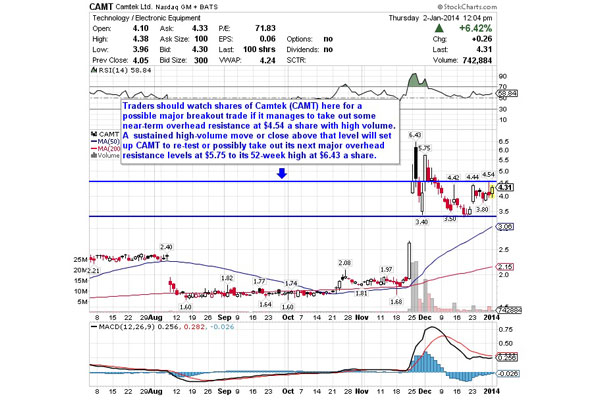
One under-$10 semiconductor player that's quickly moving within range of triggering a major breakout trade is Camtek (CAMT), which designs, develops, manufactures and markets automated solutions dedicated for enhancing production processes and yield for the semiconductor manufacturing and packaging and the printed circuit board and integrated circuit substrate industries. This stock has been on fire during the last three months, with shares up a whopping 154%.

If you take a look at the chart for Camtek, you'll notice that this stock has found buying interest over the last month, each time it has pulled back towards $3.40 to $3.80 a share. Shares of CAMT are now starting to spike higher off those support levels and it's quickly moving within range of triggering a major breakout trade above some key near-term overhead resistance levels.

Traders should now look for long-biased trades in CAMT if it manages to break out above some near-term overhead resistance at $4.54 a share with high volume. Look for a sustained move or close above that level with volume that hits near or above its three-month average action of 1.86 million shares. If that breakout triggers soon, then CAMT will set up to re-test or possibly take out its next major overhead resistance levels at $5.75 to its 52-week high at $6.43 a share.

Traders can look to buy CAMT off any weakness to anticipate that breakout and simply use a stop that sits right below some near-term support levels at $3.80 or at $3.40 a share. One can also buy CAMT off strength once it starts to take out $4.54 a share with volume and then simply use a stop that sits a comfortable percentage from your entry point.

Penn West Petroleum

Another under-$10 stock that's starting to trend within range of triggering a big breakout trade is Penn West Petroleum (PWE), which is engaged in the business of acquiring, exploring, developing, exploiting and holding interests in petroleum and natural gas properties and related assets. This stock has been under pressure by the bears during the last three months, with shares off by 24%.

If you take a look at the chart for Penn West Petroleum, you'll notice that this stock has been trending sideways over the last two months, with shares moving between $7.89 on the downside and $8.84 on the upside. Shares of PWE are now starting to spike higher above its recent low of $8.14 a share and it's quickly moving within range of triggering a breakout trade above the upper-end of its recent sideways trading chart pattern.

Market players should now look for long-biased trades in PWE if it manages to break out above some near-term overhead resistance levels at $8.84 a share to its 50-day moving average of $8.96 a share with high volume. Look for a sustained move or close above those levels with volume that hits near or above its three-month average action of 2.43 million shares. If that breakout hits soon, then PWE will set up to re-test or possibly take out its next major overhead resistance levels at its 200-day moving average of $10.07 to $11 a share. Any high-volume move above those levels will then give PWE a chance to tag $11.50 to $12 a share.

Traders can look to buy PWE off any weakness to anticipate that breakout and simply use a stop that sits right below some key near-term support levels at $8.14 a share or at $7.89 a share. One can also buy PWE off strength once it starts to clear those breakout levels with volume and then simply use a stop that sits a comfortable percentage from your entry point.

Biodel

One under-$10 specialty biopharmaceutical player that's starting to trend within range of triggering a big breakout trade is Biodel (BIOD), which is focused on the development and commercialization of innovative treatments for diabetes. This stock has been hit hard by the bears over the last three months, with shares down by 24%.

If you take a look at the chart for Biodel, you'll notice that this stock is ripping higher here right off its 50-day moving average of $2.32 a share with strong upside volume. Volume on Thursday has so far registered over 750,000 shares, which is well above its three-month average action of 445,084 shares. This move is quickly pushing shares of BIOD within range of triggering a big breakout trade.

Traders should now look for long-biased trades in BIOD if it manages to break out above some near-term overhead resistance levels at $2.52 to $2.60 a share with high volume. Look for a sustained move or close above those levels with volume that hits near or above its three-month average action of 445,084 shares. If that breakout triggers soon, then BIOD will set up to re-test or possibly take out its next major overhead resistance levels $3 to its 200-day moving average of $3.39 a share. Any high-volume move above $3.39 will then give BIOD a chance to tag $4 a share.

Traders can look to buy BIOD off weakness to anticipate that breakout and simply use a stop that sits right below some key near-term support at $2.10 a share. One can also buy BIOD off strength once it starts to clear those breakout levels with volume and then simply use a stop that sits a comfortable percentage from your entry point.

China Ming Yang Wind Power Group

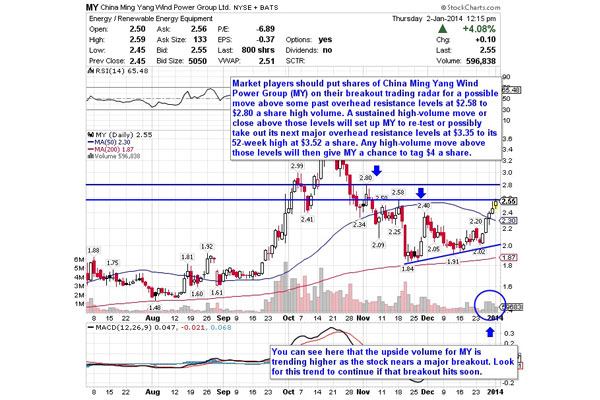
Another under-$10 stock that looks ready to trigger a big breakout trade is China Ming Yang Wind Power Group (MY), a wind turbine manufacturer in China. This stock has been very hot over the last six months, with shares up sharply by 52%.

If you take a look at the chart for China Ming Yang Wind Power Group, you'll notice that this stock has been uptrending over the last few weeks, with shares moving higher from its low of $1.91 to its intraday high of $2.59 a share. During that uptrend, shares of MY have been consistently making higher lows and higher highs, which is bullish technical price action. That move has now pushed shares of MY within range of triggering a big breakout trade.

Market players should now look for long-biased trades in MY if it manages to break out above some past overhead resistance levels at $2.58 to $2.80 a share high volume. Look for a sustained move or close above those levels with volume that hits near or above its three-month average action of 1.56 million shares. If that breakout hits soon, then MY will set up to re-test or possibly take out its next major overhead resistance levels at $3.35 to its 52-week high at $3.52 a share. Any high-volume move above those levels will then give MY a chance to tag $4 a share.

Traders can look to buy MY off weakness to anticipate that breakout and simply use a stop that sits right below its 50-day moving average of $2.30 a share, or near more support at $2.02 a share. One can also buy MY off strength once it starts to clear those breakout levels with volume and then simply use a stop that sits a comfortable percentage from your entry point.

Cytokinetics

One final under-$10 biopharmaceutical player that's quickly moving within range of triggering a major breakout trade is Cytokinetics (CYTK), which is focused on the discovery and development of small molecule therapeutics that modulate muscle function for the potential treatment of serious diseases and medical conditions. This stock has been hit hard by the sellers over the last six months, with shares off sharply by 46%.

If you take a look at the chart for Cytokinetics, you'll notice that this stock has been trending sideways and consolidating for the last three months, with shares moving between $5.99 on the downside and $7.49 on the upside. This stock recently formed a double bottom chart pattern at $6.06 to $5.99 a share. Shares of CYTK have now started to trend higher off that bottom and back above its 50-day moving average of $6.46 a share. That move is quickly pushing shares of CYTK within range of triggering a major breakout trade above the upper-end of its recent sideways trading chart pattern.

Traders should now look for long-biased trades in CYTK if it manages to break out above some near-term overhead resistance at $6.97 a share, and then once it clears some past overhead resistance at $7.31 to $7.49 a share with high volume. Look for a sustained move or close above those levels with volume that hits near or above its three-month average action of 428,434 shares. If that breakout hits soon, then CYTK will set up to re-test or possibly take out its next major overhead resistance levels at its 200-day moving average of $8.32 a share to $8.94 a share. Any high-volume move above $8.94 a share will then give CYTK a chance to re-fill some of its previous gap down zone from September of 2013 that started at $11 a share.

Traders can look to buy CYTK off weakness to anticipate that breakout and simply use a stop that sits right below some key near-term support levels at $6.19 a share or at $5.99 a share. One can also buy CYTK off strength once it starts to take out those breakout levels with volume and then simply use a stop that sits a comfortable percentage from your entry point.

To see more hot under-$10 equities, check out the Stocks Under $10 Setting Up to Explode portfolio on Stockpickr.

-- Written by Roberto Pedone in Delafield, Wis.

RELATED LINKS:

 >>5 Stocks With Big Insider Buying
>>Must-See Charts: 5 Trades to Take
>>5 Dividend Stocks Ready to Pay You More in 2014

Follow Stockpickr on Twitter and become a fan on Facebook.

At the time of publication, author had no positions in stocks mentioned.

Roberto Pedone, based out of Delafield, Wis., is an independent trader who focuses on technical analysis for small- and large-cap stocks, options, futures, commodities and currencies. Roberto studied international business at the Milwaukee School of Engineering, and he spent a year overseas studying business in Lubeck, Germany. His work has appeared on financial outlets including CNBC.com and Forbes.com. You can follow Pedone on Twitter at www.twitter.com/zerosum24 or @zerosum24.

Hot Energy Companies To Watch In Right Now


Saturday, February 8, 2014

Aerospace and Defense

The aerospace and defense industry performed much better than the broader market in 2013. Here, we examine the continued appeal of defense and aerospace, thanks to robust sales, plus an average valuation on par with the overall market, explains Mark Salzinger, editor of The Investor's ETF Report.

This industry's two largest ETFs—iShares Aerospace and Defense (ITA) and PowerShares Aerospace and Defense (PPA)—gained more than 50% last year.

Boeing (BA) is the Number Two holding in ITA and PPA; commercial aerospace demand has been especially strong. Recent 12-month averages of aircraft orders have reached levels not seen since 2007.

Top 10 Healthcare Equipment Companies To Watch In Right Now

While defense spending is set to decline, the decrease is not as severe as originally projected. After $37 billion in cuts to the US defense budget for the fiscal year that ended in September 2013, the newest fiscal year is slated to see another $30 billion in cuts, which is about $22 billion less than military services had anticipated.

However, major defense contractors gained strongly in 2013, as their performance shows continued profitability, thanks to cost cutting and continued spending on favored military programs.

Defense contractors also tend to be more resilient than in the past. Years of consolidation have narrowed competition and given larger companies diverse operations: Lockheed Martin (LMT), for example, is not only one of the largest aerospace contractors to the US military, but the Number One information-technology provider to the entire US government.

Foreign sales are another source of revenue. Even though US defense spending is waning, America's allies in Asia are increasing their expenditures in parallel with higher defense spending in China. The Japanese military wants to spend an addition $50 billion, and South Korea plans to spend an extra $7 billion.

From among these two ETFs, we favor ITA. It has been a stronger performer than PPA over the past five years, with an annualized return of 22.4%, versus 18.8%. Its expense ratio is lower (0.46%, versus 0.66%), and it has more in assets (about $293 million, versus $92 million).

ITA holds about 40 stocks, the top ten of which account for more than 55% of the portfolio. No single stock recently accounted for more than 10%.

Boeing gets about 60% of its business from commercial aerospace and 40% from defense. United Technologies (UTX), ITA's Number One holding, generates only about half its revenue from aerospace businesses; the rest comes from a variety of industrial operations, including elevator and climate systems.

ITA's average price/earnings ratio on forward earnings of 17.7 is only slightly higher than that of the S&P 500 Index (SPX), (16.6). Earnings growth expectations for ITA's companies are also slightly higher than those of the broader market (10.3%, versus 9.8%, respectively).

So, while aerospace and defense stocks are no obvious bargain, neither are they especially pricey, relative to earnings, growth, or the broader market, despite strong recent performance.

Subscribe to The Investor's ETF Report here…

More from MoneyShow.com:

General Dynamics: Defensive Gains

Raytheon: Fundamental Powerhouse

Boeing: Big, Safe, and Under-Appreciated

Friday, February 7, 2014

Australia central bank: Rate cut still possible

SYDNEY--Australia's central bank said interest rates may still be cut again next year as the local currency remains "uncomfortably high," hindering a shift away from mining-dependent growth as a long resources boom slows.

In minutes of its Dec. 3 policy meeting, published Tuesday, the Reserve Bank of Australia said a recovery in non mining industries remained "very weak," tempering the outlook for growth.

The central bank last week held interest rates steady at a record-low 2.5% for the fourth-straight monthly meeting, reiterating that it was looking for stronger signs a recovery in non mining industries was more than a blip before it would be prepared to shift rates.

"It was prudent to hold the cash rate steady while continuing to gauge the effects of earlier reductions, but not close off the possibility of reducing it further," the meeting minutes said. "While the exchange rate had depreciated over the month, members agreed that it remained uncomfortably high and a lower level would likely be needed to achieve balanced growth in the economy," the central bank added.

Reserve Bank Governor Glenn Stevens has been repeatedly attempting to jawbone the currency lower in recent months, saying he wouldn't rule out intervention. Last week he said predicted it could fall to 85 U.S. cents over time. The remarks saw it sink to a three-month low of 89 U.S. cents.

The Australian dollar is down about 14% against the U.S. dollar so far this year.

-Write to James Glynn at james.glynn@wsj.com

Subscribe to WSJ: http://online.wsj.com?mod=djnwires

Thursday, February 6, 2014

Apple's Tortured Relationship with the Enterprise

NEW YORK (TheStreet) -- After the desktop publishing bonanza of the late 1980s that was launched by the early Macs and laser printers, Apple (AAPL) sought to further develop its position in the business world.

But as history tells it, a mistake by CEO John Sculley opened the door to Microsoft's (MSFT) Windows. By 1995, Microsoft was briskly improving its control of the enterprise with, after some false starts, Windows 95. At the time, the casual and damaging consensus was that Windows 95 was "just as good as a Mac," and by early 1996 Apple was foundering.

This is not the place to retell the story of Steve Jobs's return. It's been superbly told by many others, in book-length form. What I do want to do, however, is relate some of the interesting observations I encountered from my own experience because they shed light on Apple's topsy-turvey relationship with the enterprise over the years, especially since 2000.

CIO Encounters

When I worked for Apple in Federal sales, starting in 2003, I was assigned to sell into the Federally Funded R&D Centers. I met with almost every CIO of those organizations, and they were generally in the Microsoft camp. Microsoft products were designed for the enterprise from top to bottom. Microsoft understood the business needs of the enterprise and government and "checked the boxes" for the CIO's needs. So firmly entrenched was Microsoft that, even when confronted with a superior, more secure UNIX OS, called Mac OS X, they generally declined. That's because convincing one person in an organization, even a CIO, won't turn the ship around. Plus, an OS is just a point solution. The whole suite of business services, such as the Microsoft Exchange Server, was more critical to a business in their view. Finally, Macs being the very best were too expensive, and every business wanted the cheapest possible hardware for its cubicle dwellers. Of course, I had champions in some of those agencies, but by and large if an organization was already Mac-friendly, and they were few, sales were brisk. Otherwise, it was an uphill battle. Organizations don't change unless there's a catastrophe. (And in some cases, there were some major security events with Windows XP that earned Apple important customers.) But those were small battles, not the larger war.

Stock quotes in this article: AAPL, MSFT 

In October, 2001 Apple launched the iPod. I was in the room when Steve Jobs pulled the first iPod out of his pocket and gleamed at us. This was a new beginning. From that day on, Apple was able to get on the consumer bandwagon and appeal to individual purchase authority. If a product were very cool and well made and simple and fun, out came the individual's credit card. That has been Apple's mantra and key to success ever since.

Back to the enterprise. When it came to selling Macs of any kind, Apple was, in my impression, carefully treading so that it could dance its own dance. What was at stake was innovation. By that I mean that businesses and government can be plodding -- and demanding all at the same time.

While Microsoft catered to those businesses, Apple knew that it had to move relentlessly forward with technology in order to claim that it makes the very best products. Today, we need only look at the organizations still using Windows XP, even though Microsoft and the U.S. government have pleaded with them to leave that 14-year-old OS behind.

The Influence of Steve Jobs

Very often, the Apple federal and enterprise sales teams would look to the charisma and influence of Jobs to inspire a customer in special executive briefings on the Apple campus. These were customers critical to Apple's business sales. Sometimes it worked very well, but there were times when Jobs declined to intervene with his influence. It's possible he sensed that a particular technical area was unwise for Apple to pursue, like supercomputing and compute clusters. Plus, there were probably times when he was vey focused on his pet projects, like the iPad and iPhone, and he felt that if his sales team were really, really good, they could close the deal without him.

Finally, as I mentioned above, there's always that enterprise demon -- businesses and government want stability and long-term commitments. That's something Apple couldn't engage in if it were to stay in the business of radical advances in consumer technology. Apple's approach has generally been to put great products out there while moving forward briskly. If an organization embraces those Apple products, all's well. But if an organization thinks it can obtain concessions from Apple by making high-value purchases, that generally hasn't worked out well. All this explains why Apple pursues the enterprise on its own terms and why there are organizations that embrace Apple and those that consider Apple products and services (or lack thereof) unsatisfactory for their broad enterprise needs.

Stock quotes in this article: AAPL, MSFT 

There was a time in the early days of [Mac] OS X (2001-2005) when the security situation was a nightmare with its competition, Windows XP. If perhaps Jobs had gone all out, at every opportunity, to sway those organizations besieged with Windows viruses, maybe things would have been different.

But even when faced with security calamities, the approach was not to change platforms. Instead, it was for Microsoft to fix the problems, and the company pretty much did that with Vista and Windows 7. For some very personal history on the opportunities Apple may have missed, see, for example, Could Apple have been even more successful?

The Bottom Line

Today, it seems like a simple matter to suggest that if only Apple tried harder, it could generate much more Mac revenue in business and government. But the fact is, Apple has morphed into a very successful consumer electronics company. Enterprise sales are sought and won daily, and NASA is a major Apple customer. But Apple is always following its own vision, advancing the state-of the-art briskly, and asking its enterprise customers to be on that ride with them.

Now, in the post-PC era, with drastic reductions in PC sales and most consumer and enterprise customers finding that the classic tablet, conceived by Apple in the iPad, meets their needs, Apple's forward-looking vision has been vindicated. Try as Microsoft might, the Surface tablets are not the future whereas Apple has significant iPad and iPhone penetration in the enterprise. Before the iPhone and iPad, it was a rocky ride for Apple's Mac in the PC world. But the decision to race into the future with the iPhone and iPad looks to have paid off.


At the time of publication the author had no position in any of the stocks mentioned. Follow @jmartellaro This article represents the opinion of a contributor and not necessarily that of TheStreet or its editorial staff.

Stock quotes in this article: AAPL, MSFT  John Martellaro was born at an early age and began writing about computers soon after that. He is a former U.S. Air Force officer and has worked for NASA, White Sands Missile Range, Lockheed Martin Astronautics, the Oak Ridge National Laboratory and Apple. At Apple he worked as a Senior Marketing Manager, a Federal Account Executive and a High Performance Computing manager. John is currently the Senior Editor for Analysis and Reviews at The Mac Observer. His interests include skiing, chess, science fiction and astronomy.

Sunday, February 2, 2014

New tech leadership emerges as giants’ growth s…

Tech investors should look for the next big thing.

Investors' infatuation with a few well-known technology companies is starting to cost them, as new leadership emerging from the dynamic industry produces some of the best stock performance. While investors cling to the biggest or most hyped tech names, including Apple, Google and Amazon, the industry is reinventing itself, and that's leading to disconnects in stock performance. Apple's shares have inched up 6% this year, while the Nasdaq composite index has gained 33.7%.

While it's too early to guess where the future leaders will come from, some investors aren't wasting any time trying to make sure they're positioned for where the industry goes next.

"Overall, tech investors search for best growth ideas and tend to rotate from slowing-growth companies, such as Apple the past year, for faster-growth companies," says Mike Walkley, analyst at Canaccord Genuity.

Top 10 International Stocks To Invest In 2014

BIG STOCKS: They're not only ones behind bull run

Knowing where future trends lie is critical for tech investors. Companies with the winning products or services in tech can be outsize beneficiaries in technology markets, which are often winner-takes-all, at least in the short run, before competition heats up and changes the game.

Finding growth is getting increasingly difficult to do as the industry slows overall. Fourth-quarter earnings growth by tech companies is only expected to be 4.1%, says S&P Capital IQ, the third lowest of the 10 tracked. Yet, some of the companies that are starting to show up on technology growth screens include those with:

• Massive earnings growth. Some smaller companies, most of which are far from household names, are putting up blistering numbers. Other tech companies, such as 3-D printer firm 3D Systems, are tapping new areas of growth, and boosted earnings by 43% the past! 12 months, due in part to pulling off 40 acquisitions the past year, says Brian Drab of William Blair. All told, there are 16 tech stocks trading on major U.S. exchanges that have posted average annual revenue and earnings growth of 20% or more the past two years, and are expected to grow that fast or faster the next two years, says S&P Capital IQ. One of those is professional social-networking company LinkedIn, which has emerged as the blue chip of the social-media stocks.

• Winning positions despite shifts in players. Smartphone handset makers may be pounding on each other to take market share, but some companies are thriving behind the scenes no matter what. Qualcomm designs the chips that go into 95% of smartphones with high-speed 4G LTE capability, says Walkley. No matter who wins, Qualcomm profits, which is clear from the company's 30% earnings growth last year. Similarly, InvenSense makes a variety of devices used to help handheld devices sense direction.

• Possible big-cap tech turnaround stories. Comebacks in tech stocks are rare, but they're still possible. Big profits can come to investors who properly pinpoint fallen tech giants that right the ship. Investors are betting on memory maker Micron, technology firm Hewlett-Packard and former Internet darling Yahoo, pushing their shares up 244%, 93% and 84%, four of the best performances this year of the tech stocks in the S&P 500. And IAC/InterActiveCorp, an early Internet pioneer that operates a variety of online media companies, is one of the companies with 30% growth in the past two years and expected to grow 30% again the next two, says S&P Capital IQ.

Social-media companies will continue to attract more investor attention as they show how fast they can grow and tech trends benefit their bottom lines, says Jim Kelleher of Argus Research. "While innovation is necessary in every sector, in technology, it is rapidly becoming 'innovate or die.' We have seen tremendous sector disruption caused by social media, e! nterprise! mobility, analytics and big data, and virtualization and cloud," he says.